
Your Location:Home > Products > Amino Acids > Inositol (Myo-Inositol)
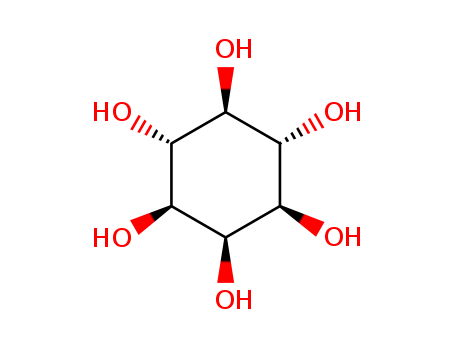
CasNo: 87-89-8
MF: C6H12O6
Appearance: white powder
Buy high quality and low price Inositol (Myo-Inositol) 87-89-8 now We provide high quality Inositol (CAS 87-89-8), at a very affordable prices to our customers.
Inositol (hexahydroxycyclohexane) is a widely distributed natural constituent of plant and animal tissues. The animal tissues richest in inositol are brain, heart, stomach, kidney, spleen, and liver, where it occurs free or as a component of phospholipids. Among plants, cereals are rich sources of inositol, particularly in the form of polyphosphoric acid esters, called phytic acids. Although there are several possible optically active and inactive isomers, considerations of inositol as a food additive refer specifically to optically inactive cis-1,2,3,5-trans-4,6-cyclohexanehexol, which is preferably designated myo-inositol. Pure inositol is a stable, white, sweet, crystalline compound. The Food Chemicals Codex specifies that it assay not less than 97.0 percent, melt between 224 and 227°, and contain not more than 3 ppm arsenic, 10 ppm lead, 20 ppm heavy metals (as Pb), 60 ppm sulfate, and 50 ppm chloride. Inositol was thought for a time to be a vitamin because experimental animals on a synthetic diet developed clinical signs that were corrected by inositol supplementation. However, no cofactor or catalytic function for inositol has been found; it can be synthesized and occurs in relatively high concentration in animal tissues. These factors argue against its classification as a vitamin. A dietary requirement in man has not been established.
A growth-factor and structural element of secondary messengers in eukaryotic cells
The CAS number of Inositol is 87-89-8.
More information of Inositol 87-89-8 are:
|
CAS Number |
87-89-8 |
|
Density |
2.039 g/cm3 |
|
Melting Point |
222-227 °C(lit.) |
|
Boiling Point |
291.326 °C at 760 mmHg |
|
Flash Point |
143.387 °C |
|
Refractive Index |
1.6170 (estimate) |
|
HS CODE |
2906.13 |
|
PSA |
121.38000 |
|
LogP |
-3.83460 |
|
Pka |
12.63±0.70(Predicted) |
The chemical formula of Inositol is C6H12O6 which containing 6 Carbon atoms,12 Hydrogen atoms and 6 Oxygen atoms,and the molecular weight, and the molecular weight of Inositol is 180.158
Inositol (hexahydroxycyclohexane) is a widely distributed natural constituent of plant and animal tissues. The animal tissues richest in inositol are brain, heart, stomach, kidney, spleen, and liver, where it occurs free or as a component of phospholipids. Among plants, cereals are rich sources of inositol, particularly in the form of polyphosphoric acid esters, called phytic acids. Although there are several possible optically active and inactive isomers, considerations of inositol as a food additive refer specifically to optically inactive cis-1,2,3,5-trans-4,6-cyclohexanehexol, which is preferably designated myo-inositol. Pure inositol is a stable, white, sweet, crystalline compound. The Food Chemicals Codex specifies that it assay not less than 97.0 percent, melt between 224 and 227°, and contain not more than 3 ppm arsenic, 10 ppm lead, 20 ppm heavy metals (as Pb), 60 ppm sulfate, and 50 ppm chloride. Inositol was thought for a time to be a vitamin because experimental animals on a synthetic diet developed clinical signs that were corrected by inositol supplementation. However, no cofactor or catalytic function for inositol has been found; it can be synthesized and occurs in relatively high concentration in animal tissues. These factors argue against its classification as a vitamin. A dietary requirement in man has not been established.
InChI:InChI=1/C6H12O6/c7-1-2(8)4(10)6(12)5(11)3(1)9/h1-12H/t1-,2-,3-,4+,5-,6-
Relevant articles related to Inositol:
|
Article |
Source |
|
Forced degradation of L-(+)-bornesitol, a bioactive marker of Hancornia speciosa: Development and validation of stability indicating UHPLC-MS method and effect of degraded products on ACE inhibition |
Gomes, José Hugo de Sousa,da Silva, Grazielle Caroline,C?rtes, Steyner F.,de Pádua, Rodrigo Maia,Braga, Fern?o Castro , p. 31 - 38 (2018) |
ANTAI BIO-TECH CO LTD is a quality supplier of Inositol. Our main goal is customer satisfaction. Contact us to negotiate the best price for your business on Inositol 87-89-8.
Address:Room 2108, Building 2,No. 489 Zhengli Road,Shanghai, China ,200433Email:antai@antaibio.com
Tel:0086-21-65663057Phone:+0086-13918425683